Birding Sites along our Western Cape Birding Routes
Western
South Africa is an extraordinarily biodiverse region, and
an indispensable destination for the ecotourist in southern
Africa. Indeed, there is no other area in Africa that offers
such a high level of endemism in such an accessible setting.
The region is well known among inter-national and local birders
alike for the remarkable suite of birds that is found here
and nowhere else in the world: a staggering 42 of South Africa’s
53 endemic bird species occur here, as well as 76 per cent
of southern Africa’s 181. Complimenting this unique birdlife
is the scenic and botanical wealth of western South Africa,
which is now acknowledged to contain two of the African continent’s
four biodiversity hotspots as defined by Conservation International.
In addition, local and international bird-watchers are inevitably
drawn to the region by the tourism gem of Cape Town, and by
the region’s scenic and cultural diversity, well-developed
infrastructure, high standard of accommodation, and excellent
network of national parks and provincial and private nature
reserves. A total of 613 bird species have been recorded in
this region, and a two-week trip could be expected to yield
in excess of 350 species. Indeed, over 220 species have even
been recorded around Cape Town in a single day! Although the
sheer diversity of southern Africa’s more tropical eastern
region is inevitably higher, most of the species found here
have wide distributions and extend over much of Africa. The
west, by contrast, is rich in species largely restricted to
this region, making western South African an essential destination
in both global and local terms. Furthermore, this region offers
representatives from seven of Africa’s ten endemic and
near-endemic bird families: Ostrich, Hamerkop, Guineafowl,
Secretary-bird, Mousebirds, Turacos, Woodhoopoes, African
Barbets and Sugarbirds.
Western South Africa forms part of the well-defined birding
region of southern Africa, a region that
includes South Africa, Namibia, Zimbabwe, Botswana, Lesotho,
Swaziland and southern Mozambique (as covered by local field
guides). Throughout this book, we refer to ‘endemics’
as those birds restricted to greater southern Africa, unless
explicitly stated otherwise. Near-endemics are those birds
whose ranges extend only marginally beyond the borders of
this subregion.
Visit Peter Steyn's endemic
bird photo galleries.
Taxonomy
for Birders
Click here to read about the
changing taxonomy and recent splits of birds in these regions.
Cape birding habitats
Five major biomes (broad-scale vegetation categories) occur
in western South Africa: Fynbos, Succulent Karoo, Nama Karoo,
Forest and Savanna. Within these biomes, the variation in vegetation,
topography and human alteration has created a complex array
of birding habitats. We have simplified this variation into
five major birding ‘habitats’ that encapsulate the
region’s characteristic and endemic birds. Below, we discuss
these categories and highlight those endemics (see p.5) that
are linked to a particular habitat type.
1. Cape Floral Kingdom and Fynbos
The smallest of the world’s six floral king-doms, the
tiny Cape Floral Kingdom is one of the richest biodiversity
hotspots on earth, and is almost totally restricted to the
area covered by this book. Despite occupying less than 0.05
per cent of the earth’s land surface, this small pocket
of diverse veg-
etation lying at Africa’s southern extremity holds an
astronomical 8 700 plant species. The winter-rainfall Cape
Floral Kingdom encompasses all the vegetation types in the
geographical area stretching from the Nieuwoudtville escarpment
in the northwest through to Port Elizabeth in the southeast,
and from the arc of mountain ranges to the sea. However, it
is the shrublands of the Fynbos Biome, the largest and most
prominent subset of the Cape Floral Kingdom, that lends this
region its essential character.
Fynbos (Afrikaans for ‘fine bush’ – probably
referring to the plants’ spindly stems that are unsuitable
for timber) is remarkable not only for its variety of plant
species but also for its ecological peculiarities, among them
its absolute dependence on regular fires, essential for successful
germination of many fynbos plants, and the fascinating partnerships
developed between plants and animals. Flower pollinators range
from sugarbirds and bizarre long-tongued flies to nocturnal
mice, while seed dispersal is facilitated by pheromone-laced
seed coatings that entice ants to plant them in their underground
nests, ready to germinate following the next fire.
Although pristine areas of fynbos have a very low diversity
of birds, there are some notable endemics to be seen, namely
Hottentot Buttonquail (see p.23), Cape Rockjumper (p.73*),
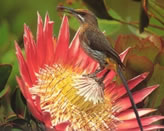
Victorin’s Warbler (p.73*), Cape Sugarbird (p.33*), Orange-breasted
Sunbird (p.33*), Cape Siskin (p.33*), and Protea Canary (p.57*).
While not restricted to fynbos, the ranges of Cape Francolin,
Agulhas Long-billed Lark (p.73*) and Cape Bulbul are largely
centred on the Cape Floral Kingdom.
Fynbos vegetation is composed largely of three conspicuous
plant groups: the large, broad-leafed proteas (favoured by
Cape Sugarbird and Protea Canary); the low, small-leafed ericas
(heath; favoured by Orange-breasted Sunbird, see picture on
p.33); and the grass-like, clumped restios (brownish ‘thatching
reeds’). All are readily recognizable. For further information,
visit the Kirstenbosch National Botanical Garden. The true
fynbos endemics are restricted primarily to the widespread
mountain fynbos that occurs on rocky slopes and mountains
of the Cape. Much rarer is lowland fynbos, which occurs on
the flats of the coastal forelands. Here, too, Renosterveld
occurs (p.63), a related vegetation type that has many bird
species in common with fynbos, such as Agulhas Long-billed
and Clapper Larks. The broad-leafed ‘strandveld’
(‘beach vegetation’) thicket, which occurs in a
narrow band along the coast, is not related to fynbos. However,
on parts of the West Coast it forms a mosaic with lowland
fynbos, and many bird species are shared (p.43).
2. Succulent and Nama Karoo
The Karoo is a vast semidesert area that is divided into two
botanically very different regions and dominates the arid
western half of South Africa. It forms part of the most ancient
desert system in the world, and is an open area of stony plains,
scattered with small shrubs, punctuated by low dunes and hills
(‘koppies’), and is very sparsely inhabited. The
Succulent Karoo Biome (Tanqua Karoo and Namaqualand) is characterized
by small succulent plants, supported by low but predictable
winter rainfall, whereas the summer-rainfall Nama Karoo Biome
(Bushmanland, the southern Kalahari, and the Karoo National
Park in Garden Route and Interior) is dominated by grasses
and low, woody shrubs. The Succulent Karoo Biome is one of
Africa’s biodiversity hotspots, and has the highest diversity
of succulent plant species in the world.
Despite these fundamental climatic and vegetation differences,
most Karoo bird specials occur in both biomes. Karoo endemics
and near-endemics include Karoo Korhaan, Ludwig’s Bustard
(p.105*), Red (p.96*), Barlow’s (p.100), Karoo Long-billed
(p.13) and Sclater’s Larks (p.96*), Black-eared Finchlark
(p.96*), Karoo and Tractrac Chats, Karoo Eremomela (p.85*),
Cinnamon-breasted Warbler (p.85*), Namaqua Warbler (p.85*),
Pale-winged Starling and Black-headed Canary (p.105*). Numerous
other species, such as Karoo Lark and Rufous-eared Warbler,
are characteristic of this region, but also extend peripherally
into other biomes.
3. Afromontane Forest
This biome is scattered discontinuously across central and
east Africa’s montane peaks, with the temperate forests
of the Cape constituting its southern fragments. In the west
of our region (Cape Peninsula and Overberg), pockets of afromontane
forest survive in moist, fire-protected areas, and along the
Garden Route large tracts extend along the coastal plain.
Although these relict forest patches are rather species poor
compared to those further north and east in Africa, Knysna
Warbler (p.32*) and Knysna Woodpecker (p.72*) are almost restric-ted
to this region.
More widespread South-ern African forest endemics occurring
here are Forest Buzzard, Knysna Lourie (p.125), Chorister
Robin (p.125*), Cape Batis, Olive Bush Shrike and Forest Canary,
and other special birds include the Crowned Eagle, Narina
Trogon (p.125*) and the dazzling Emerald Cuckoo.
4. Arid Savanna
Perhaps Africa’s most characteristic vegetation type,
this biome forms an intermediate between grassland and woodland,
and occupies the northeast of our region, the Kalahari. Rainfall
is in the form of summer thunderstorms that support good grass
cover below a varying density of thorn-trees, perhaps most
characteristically the camel-thorn (Acacia erioloba). Although
savanna supports a diverse bird community, most of these species
are widely distributed in southern Africa and further afield.
However, the savanna in this region is characteristically
arid, and endemics include Short-clawed Lark, Kalahari Robin,
Ashy Tit, Marico Flycatcher and Crimson-breasted Shrike. The
species composition present at a given locality depends on
the relative density of grass and trees; consult Kalahari
for details.
5. Coastal and Wetland
Both the Atlantic and Indian oceans flank this region, merging
at Africa’s southernmost point, Cape Agulhas (p.59).
The productive Benguela Current surges up the Atlantic coast,
bringing chilly, nutrient-rich waters from Antarctica, while
the warmer Agulhas Current moves down the east coast of Africa
from more tropical climes. The birds endemic or near-endemic
to the plentiful waters of the Benguela Current of southern
Africa’s west coast are African Penguin (p.32*), Cape
Gannet, Cape, Bank (p.21*) and Crowned Cormorants, African
Black Oystercatcher (p.33*), Hartlaub’s Gull and Damara
Tern; consult the Cape Peninsula, West Coast, Overberg and
Namaqualand chapters. Furthermore, huge numbers of migrant
pelagic seabirds are attracted to offshore waters (see Seabirding).
|