|
|
The
Three Passes: Theronsberg, Mitchell's and Bain's Kloof:
For
those not keen to face the stresses of a dash back along the
N1 to Cape Town, there is a very scenic alternative route
via Ceres and Wellington. This takes in three superb mountain
passes, all of which supply inter-esting birding in addition
to marvellous mountain landscapes.
Theronsberg
Pass, between Karoopoort and Ceres, has the gentlest landscape
of the three, with grassy slopes frequented by White-necked
Raven and, occasionally, Black
Harrier (p.57*). Between this pass and Ceres are several
small farm dams that are always worth a roadside scan for
waterfowl.
In
Mitchell’s Pass, west of Ceres, a good area to bird is
the slope behind the conspicuous Tolhuis restaurant and pub.
A footpath leads up from the shade of the Tolhuis oaks to
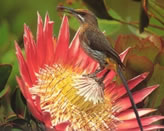
a railway line on a protea-dense slope where Protea
Canary (p.57*) may be found. Bar-throated Apalis,
and occasionally Swee Waxbill, inhabit the dense bush
just above the Tolhuis.
Bain’s
Kloof Pass, traversing the mountains above Wellington, takes
one along 30 km of dramatic curves supported by dry-stone
walls built, with the use of convict labour, some 150 years
ago. The spectacularly rugged, boulder-strewn terrain is laced
with icy streams, stained a deep tea colour by humic acid
leached from herbivore-deterring plants. These streams support
the dense vegetation favoured by Victorin’s
Warbler (p.73*), which is common in such habitat along
the entire length of the pass.
At
the summit of Bain’s Kloof Pass there is a small settlement
shaded by alien trees frequented by Fiscal Flycatcher
and, more rarely, Olive Woodpecker. Cape Rock Thrush,
often surprisingly scarce elsewhere, perch on the buildings.
The ridges in this vicinity are good for Cape
Rockjumper (p.73*) and Cape
Siskin (p.33*). Victorin’s
Warbler also occur in the denser vegetation on the
slopes. Scan overhead for Black Eagle. Birders caught
out by nightfall would do well to carefully check all outcrops
and telephone poles for the distinctive, bulky silhouette
of the (admittedly ever-scarce) Cape
Eagle Owl (p.105*).
|
This website is maintained by Birding Africa.
Please do not use any text, images or content from this site without
permission.
© Birding Africa 1997-2009 info@capebirdingroute.org
4 Crassula Way, Pinelands, 7405, Cape Town, South Africa
|

27/09/09: Dalton
Gibbs reports back from Gough
Island! Read the blog!
26/09/09: New Cape
Town Pelagics trip report from trips of 12 and 19 September
2009.
30/08/09: British
Birdwatching Fair at Rutland Water proved very successful,
with sunny weather and over 20,000 visitors. Callan's "Birding
Namibia and the Okavango" was the most highly-attended
lecture on the Saturday, with over 240 people. Congratulations
to the winners of the Birding Africa competition and the
African Bird Club raffle that we helped sponsor!
12/08/09: New Cape
Town Pelagics trip reports from August and July 2009.
Highlights: Little
Shearwater and more!
07/08/09: The
sub-adult Black Sarrowhawk visits our garden again! Read
on about Raptor Research in the Western Cape.
27/07/09: Cape
Town's Verreauxs' Eagle Chick has grown! And its sibling
never had a chance to hatch. See the pictures of the chick,
its nest and the breeding pair. Find out more about the Western
Cape Raptor Research Programme.
27/07/09: To follow modern nomenclature and systematics, we've
adopted the IOC
World Bird List, Version 2.1.
13/07/09: The 8th
African Bird ID Challenge has launched! Win a 50% discount
on a Cape Town Pelagics
trip, a copy of Southern
African Birdfinder, or African
Bird Club membership for 1 year.
6 July 09: Cape
White-eye research in our garden.
2 July 09: Cape
Town's Verreauxs' Eagle Chick has hatched! See the pictures
of the chick, its nest and the breeding pair. Find out more
about the Western Cape Raptor Research Programme.
2 July 09: Campbell
Fleming, a Cape Town scholar, avid birder and photographer,
joined Birding Africa last month as an intern. Click here,
to see what he got up to.
2 July 09: New pelagic
trip reports from the Cape Town Pelagics trips in June
2009. Highlights: Slenderbilled
Prion and Leach's Storm Petrel
30 july 09: Our latest Cape Fynbos and Karoo trip
reports feature Hottentot
Buttonquail, Cinnamon-breasted
Warbler and other fynbos and Karoo endemics...
26 June 09: Tungsten
mining threatens RAMSAR site, South Africa's Verlorenvlei.
Read the Media Release.
22 June 09: Claire
Spottiswoode, one of the Cape Birding Route founders,
was part of the exploratory team at Mount Mabu. The mountain
is part of the newly discovered largest
rainforest in Southern Africa.
11 June 09: A colour-ringed
Black Sparrowhawk visits the Birding Africa office garden.
Read why it's a 10 months old male!
14 June 09:
Wildlife
at the office of The Cape Birding Route, Birding Africa
and Cape Town Pelagics.
31 May 09:
Michel Watelet wins the 7th African Bird Club & Birding Africa
ID Challenge. Test your African birding skills and WIN
a Birding
Africa Cape town day trip or a copy of the Birdfinder!
30 May 09:
A tragedy unfolds at Kommetjie south of Cape town as 44 beached
False
Killer Whales were shot. Click here for more details and
pictures.
14 March 09: Raptor
Watch in Cape Town on 14 March 09
|
|