Rooi
Els to Betty's Bay:
East of False Bay, the contours of the Hottentots
Holland plunge precipitously into the sea, creating a spectacular
stretch of coastline where mountain fynbos and marine specials
can be seen virtually alongside each other. Heading east of
Cape Town on the N2 national road, pass through Somerset West
and turn right onto the R44 (signposted ‘Gordon’s
Bay/Kleinmond’). Continue to the T-junction at the edge
of the town of Gordon’s Bay, and turn left onto the scenic
and dramatically sinuous coastal road that meanders southwards
to the holiday village of Rooi Els.
At
the edge of the village, the road crosses the Rooi Els river
before veering to the left and heading steeply up a hill towards
Betty’s Bay. To look for Cape
Rockjumper (p.73*), take the second turn-off to the
right (an unsurfaced road), just as the R44 begins its ascent.
Park at the gate about 1 km further on, and continue on foot.
Look out for rockjumpers on the left-hand side for the next
2 km, and for Black Eagle, Ground
Wood-pecker (p.105*) and Cape Rock Thrush.
A
little further east on the R44 lies the village of Betty’s
Bay and nearby Stoney Point, site of one of only two mainland
colonies of African
Penguin (see pp.24 and 32*). On the lower mountain
slopes of the dramatic Kogelberg range is the Harold Porter
Botanical Garden, offering good fynbos and forest birding.
To reach Stoney Point, take the signposted right turn towards
the coast, just before the series of lakes on your right as
you enter the rambling village of Betty’s Bay. The African
Penguin colony is smaller than that at Boulders Beach
on the Cape Peninsula (p.24) and usually hosts less than 100
breeding pairs. One unique problem that has faced the Stoney
Point colony was devastating predation by a Leopard (Panthera
pardus) that descended from the adjacent mountains. Bank
Cormorant (p.21) also breeds here, alongside the more
common Crowned, Cape and White-breasted Cormorants.
The
Harold Porter Botanical Garden lies conspicuously signposted
on your left just past the commercial centre of Betty’s
Bay, and is a fine place for a few hours gentle ramble. The
cultivated gardens are quite small, but surrounded by moist
mountain fynbos dissected by two forested ravines, Disa Kloof
(to your left) and Leopard Kloof (to your right). From the
entrance gate, head up through the cultivated gardens to the
solidly-built bridge over the Disa Kloof stream, and continue
along the path up the kloof itself. Common birds of the lower
gardens are Black Saw-wing Swallow, Cape Bulbul,
Karoo Prinia, Southern Boubou, Malachite,
Orange-breasted
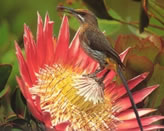
(p.33*) and Lesser Double-collared Sunbirds, Yellow-rumped
Widow, Bully Canary and conveniently accessible
Cape
Siskin (p.33*). Protea
Canary (p.57*) occasionally wanders down into the
gardens, but is by no means regular here. There are usually
swifts and swallows foraging overhead (including Rock Martin
and African Black and Alpine Swifts), alongside
soaring raptors (most commonly Black Eagle and Jackal
Buzzard).
The
forested path up Disa Kloof leads to a small, bitterly black
dam, and ends a few hundred metres further on where a waterfall
interrupts the stream. The forest along this path provides
Bar-throated Apalis, Cape Batis, Paradise
(summer) and Dusky Flycatchers, and occasionally Swee
Waxbill. During late summer, spectacular Red Disa (Disa
uniflora) orchids can be seen clinging to the dripping
and slippery cliffs adjoining the waterfall. Make your way
back to the dam and cross the bridge over its wall. A pair
of African Black Duck is often present on the dam,
if not elsewhere along the stream. A gentle path then leads
out of the kloof and around the buttress between Disa and
Leopard Kloofs, before dropping back down into the gardens.
Cape Siskin, Neddicky, Orange-breasted Sunbird,
Victorin’s
Warbler (p.73*), Grassbird and Ground Woodpecker
occur along this path. To visit Leopard Kloof, ask for a key
at the entrance to the gardens. The forest conceals a series
of pleasant waterfalls and, in addition to the forest species
mentioned above, also hosts Olive Woodpeckers and the
Cape’s westernmost regularly occurring Blue-mantled
Flycatchers, which sometimes wander down into the cultivated
gardens.
Cape
Eagle Owl (p.105*)
may be seen in the gardens at dusk by only the most fortu-nate
of birders, and has even been observed at the roadside in
Betty’s Bay village. Listen for its deep call, especially
in winter.
The
black water lakes and seeps around Betty’s Bay hold an
exciting div-ersity of amphibians, including the Micro Frog
(Micro-batrachella capensis), one of the world’s most
threatened frog species.
|