Lambert's
Bay to Verlorenvlei:
The
Cape Gannet colony
at Lambert’s Bay is a spectacle not to be missed, and
must rank as one of the birding highlights of the West Coast.
Nearly 14 000 pairs breed on the bay’s Bird Island, now
connected to the mainland by a wide concrete breakwater extending
from the harbour (see box opposite). Small numbers of African
Penguin (p.32*) can also be seen here, and all four
marine cormorants breed on the island. A host of gulls and
terns, including Swift Tern, are also present. Cape
Fur Seals (Arctocephalus pusillus) may also be seen
in the vicinity.
A
good selection of waterfowl and waders usually inhabit Jakkalsvlei,
a lake on the northern edge of town (reached from the caravan
park). Note, however, that it can be dry for the most part
in summer. Regular species here are Greater Flamingo,
South African Shelduck, and Cape and Red-billed
Teals. The handsome and localized Heaviside’s Dolphin
(see box, p.104) sometimes comes close inshore. The strandveld
vegetation near Lambert’s Bay holds all the birds profiled
on p.44; notable strandveld birds include Clapper
and Karoo Larks, Pearl-breasted Swallow, Yellow-bellied
Eremomela and Rufous-eared Warbler.
Lambert’s
Bay can be reached most efficiently by following the N7 national
road from Cape Town to Clanwilliam, and then taking the tarred
R364 towards the coast (look out for Anteating Chat
along the way). It can thus be easily visited as a detour
from the N7 while en route to Namaqualand or Bushmanland,
and is well combined with a visit to Kransvlei Poort (see
overleaf). Those with a little more time may wish to travel
along the rather poor unsurfaced roads leading south from
Lambert’s Bay towards Velddrif, that offer pleasant wetland
and strandveld birding (see below).
Follow
the coastal road south from Lambert’s Bay towards Elands
Bay (look out for the uncommon Chat Flycatcher), and,
after 11.8 km (just before the railway bridge), turn right
to follow the railway line until you reach Wadrifsoutpan (‘wagon
drift saltpan’) after about 1 km. This is a private road,
and you are not permitted to proceed past the toll station
adjacent to the pan. Wadrifsoutpan is split in two by the
railway line, and the smaller seaward section is worth searching
for a selection of waterbird and wader species, including
South African Shelduck, Cape Teal and Greater
Flamingo. However, it can be largely dry in summer. A
wide variety of strandveld birds occur here, most notably
Cape Long-billed and Clapper
Larks (p. 116*).
Continue
along the unsurfaced road to Elands Bay, which is situated
at the mouth of the bird-rich Verlorenvlei (‘lost lake’).
At Elands Bay, turn southwards along the road that crosses
the vlei, and turn to the left at the T-junction on the southern
bank. Scan the reedbed edges (such as those in the vicinity
of the road bridge) for Little Bittern, African
Rail, Red-chested Flufftail, Purple Gallinule,
Purple Heron, Malachite Kingfisher and African
Marsh Harrier. The rocky slopes lying south of the T-junction
hold a host of scrub birds, including Southern Grey Tit.
A pair of Black Eagles breeds on the nearby cliffs
and are often seen overhead. You may wish to continue along
the southern edge of the lake for a few more kilometres, as
a wide diversity of waterbird species may be seen from the
road. These include Great Crested Grebe, White Pelican,
Greater and Lesser Flamingoes, South African
Shelduck, African Fish Eagle, Caspian Tern
and a variety of waders.
Retrace
your route to Elands Bay, then turn right onto the R366. This
follows the 40-km length of Verlorenvlei inland towards Redelinghuys
(please ask the landowners’ permission should you wish
to reach the lake itself at any point), before heading south
to Aurora. The mountains to the east of Aurora hold a number
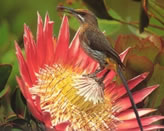
of interesting species, including Protea
Canary (opposite), and Black and Booted
Eagles. The tarred road resumes from Aurora southwards,
and ultimately intersects with the R399, 41 km to the east
of Velddrif.
|